What Is DNSSEC? 7 Things Every Developer Should Know (With Examples)
November 11, 2026 · Security
Every time you type a domain name, your computer trusts the first DNS answer it gets. So what is DNSSEC? A set of extensions that adds cryptographic signatures to DNS records, so a resolver can verify an answer really came from the domain's owner and was not changed on the way. This guide covers it in 7 parts: the definition, the attack it stops, how signing works, the chain of trust, the record types, a check you can run yourself, and what DNSSEC does not do.
What is DNSSEC?
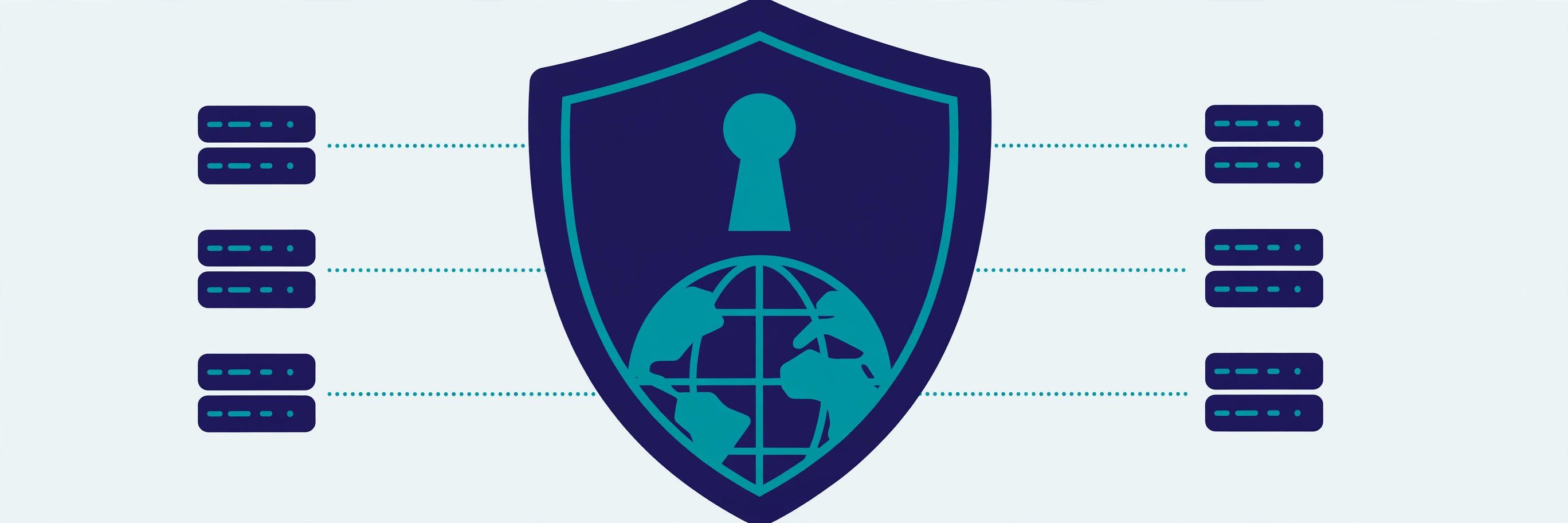
DNSSEC — the Domain Name System Security Extensions — adds cryptographic signatures to DNS records, letting resolvers verify responses came from the authoritative source and were not tampered with in transit. Without it, DNS queries are answered in plaintext with no authentication: a resolver trusts whatever reply arrives first.
The core specifications are RFC 4033, RFC 4034, and RFC 4035, published by the IETF in March 2005. Adoption was slow — the root zone itself was not signed until 15 July 2010 — and deployment is still patchy: most top-level domains are signed, but only a minority of resolvers validate the signatures. The ones that do will refuse a forged answer outright. Our DNS guide covers the lookup itself; DNSSEC is the layer that makes the answer trustworthy.
The problem it solves: DNS cache poisoning
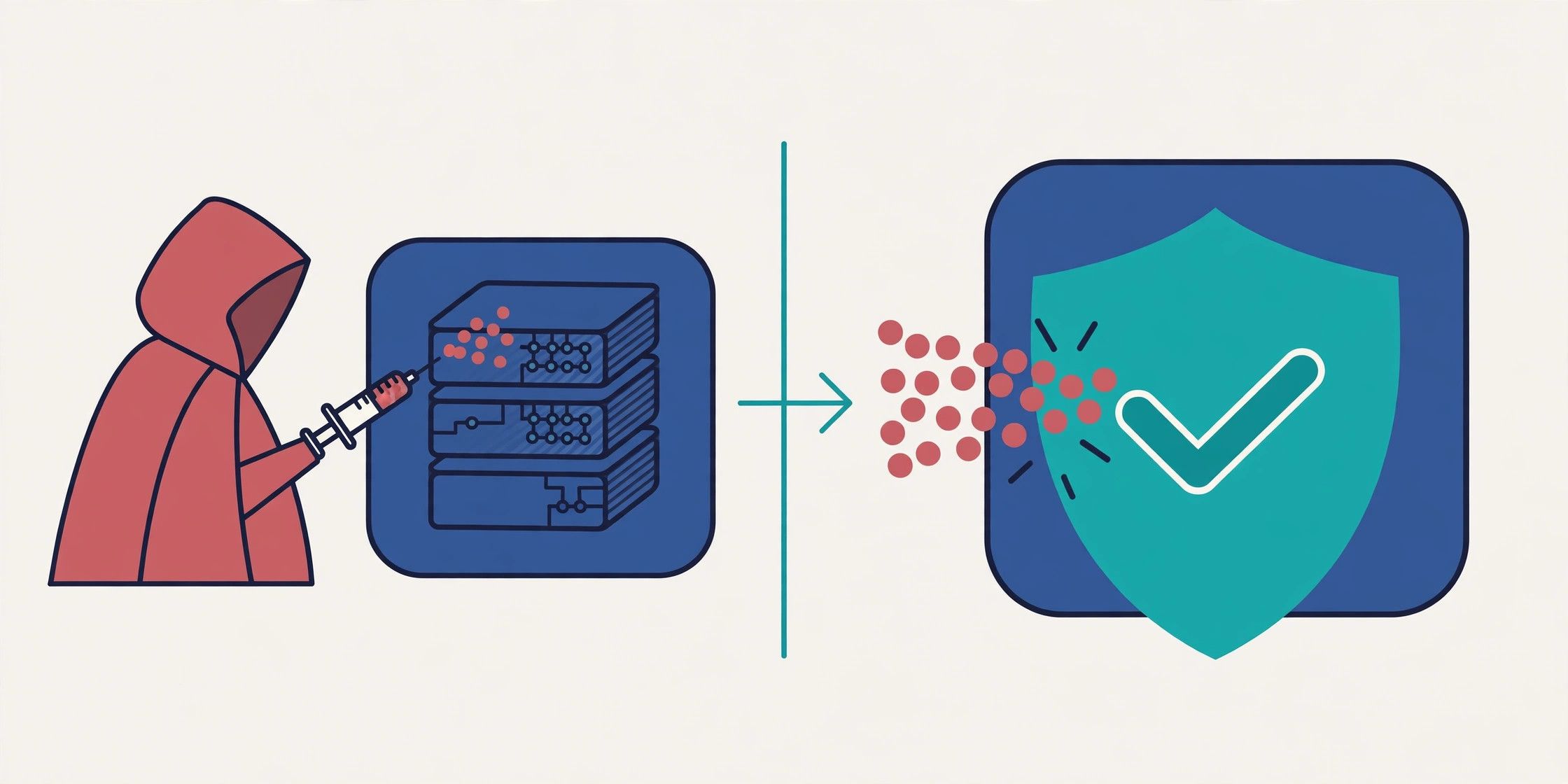
In cache poisoning, an attacker injects a false DNS record into a resolver's cache. From then on, everyone on that resolver gets the attacker's IP for your domain — their browser shows your name while talking to the attacker's server. In September 2014, researchers found email meant for Yahoo, Hotmail, and Gmail routed through rogue mail servers instead — DNS does not check credentials before accepting an answer.
The attack stopped being theoretical in 2008, when Dan Kaminsky demonstrated practical cache poisoning at scale. His work accelerated DNSSEC deployment: a forged record cannot carry a valid signature. The IP address your browser connects to is only as trustworthy as the DNS answer that supplied it — see our IP address guide for what that address means.
How DNSSEC signs a zone: RRSIG and DNSKEY
DNSSEC digitally signs records with public-key cryptography. First, all records of the same type at the same name are grouped into a resource record set, or RRset. It is the whole RRset that gets signed, not individual records.
Each zone has two kinds of key:
- Zone-signing key (ZSK). The private ZSK signs every RRset in the zone; each signature is stored beside the records as an
RRSIGrecord. The public ZSK is published in aDNSKEYrecord for resolvers to verify. Rotating a ZSK is easy: generate a new one, re-sign, publish the new public key. - Key-signing key (KSK). The private KSK signs only the
DNSKEYset itself. The public KSK is published in a secondDNSKEYrecord. This separates the key that changes often (ZSK) from the key that anchors trust (KSK): swapping a KSK means updating the parent zone too.
A validating resolver then checks mechanically: fetch the answer and its RRSIG, fetch the DNSKEY records, verify the answer with the ZSK, then the DNSKEY set with the KSK. If every check passes, the answer is genuine. The pattern matches the signatures in our JWT guide: a private key signs, a public key verifies — the only question is whom you trust with the public key.
The chain of trust: root, TLD, your domain
Trust inside one zone is not enough: the KSK signs itself, and a self-signed key proves nothing. DNSSEC connects zones with the delegation signer (DS) record: the zone operator hashes the DNSKEY record holding the public KSK and hands it to the parent zone, which publishes it as a DS record. When a resolver is referred to a child zone, the parent supplies the DS record; the resolver hashes the child's public KSK and compares it to the DS. A match means the child's key — and every record in the zone — is trusted.
The chain repeats upward: your domain's DS lives in the TLD zone, the TLD's in the root zone — and the root has no parent. The root's key is trusted because of a human process, not a cryptographic one: in the Root Signing Ceremony, selected people from around the world sign the root DNSKEY set in a public, audited procedure. Resolver operators install that root public key once, as a trust anchor, and everything else chains down from it.
That anchor is not frozen in time: on 11 October 2026 the root zone's signing key rolled over from KSK-2017 (tag 20326) to KSK-2024 (tag 38696) — only the second root key rollover in DNSSEC's history. The new key had been in the root zone since January 2025, giving resolvers almost two years to learn it. IANA plans to publish KSK-2017 with the revoke bit set on 11 January 2027 and remove it from the root zone on 22 March 2027. A validating resolver that only trusted the old key kept working from cache, then failed every lookup once its cached root key set expired — a reminder that the trust anchor is infrastructure to maintain, not install once and forget.

The record types you'll meet
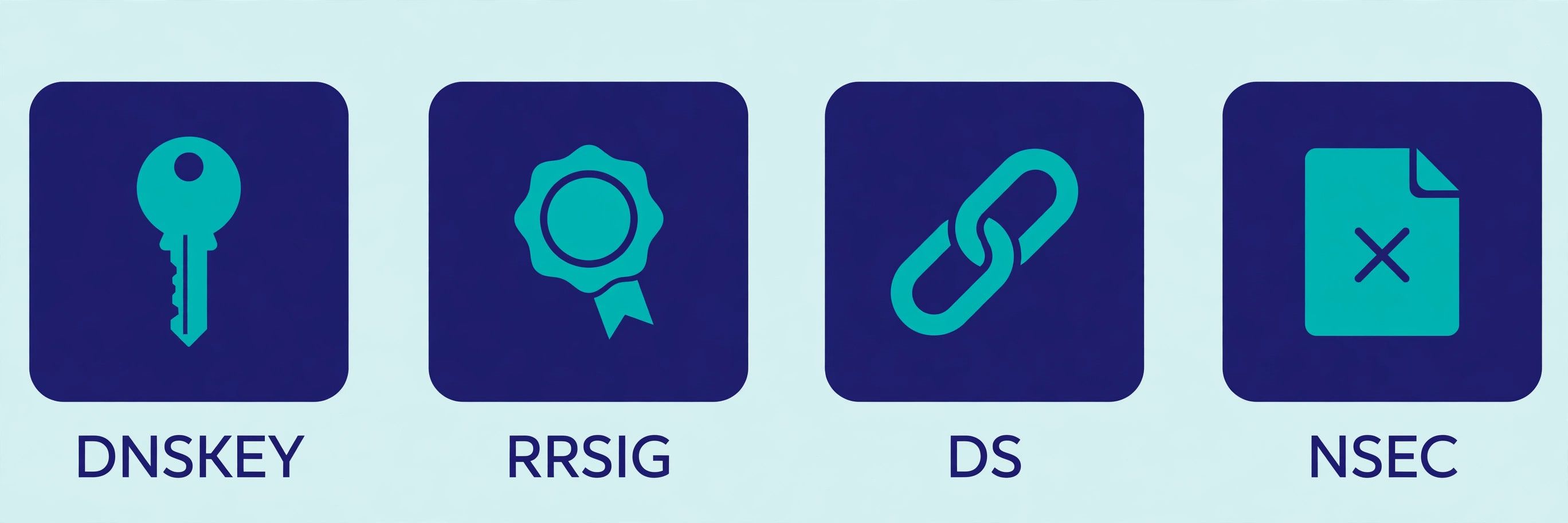
DNSSEC adds only a handful of record types; four of them do almost all the work:
| Record | Lives in | What it does |
|---|---|---|
DNSKEY | Your zone, at the apex | Publishes the public ZSK and KSK so resolvers can verify signatures. |
RRSIG | Your zone, beside each RRset | The digital signature over one RRset, made with the private ZSK (or KSK, for the DNSKEY set). |
DS | The parent zone | A hash of your public KSK. This is the link that connects your zone's trust to your parent's. |
NSEC / NSEC3 | Your zone | Proves a name does not exist, so "no such domain" answers can be authenticated too. |
The last row solves a subtle problem: an unsigned "that name does not exist" is an empty answer, with nothing to sign. NSEC answers with the next existing name — ask for store when only api, blog, and www exist, and the signed NSEC record says the next name after store is www, proving nothing sits between them. The flaw is that anyone can walk the whole zone this way; NSEC3 fixes it by hashing the names first, so the walk reveals hashes, not real subdomains.
Verified demo: check the root trust anchor yourself
You do not need a DNS server to verify the chain's top link — IANA publishes the root trust anchors as a signed file, and I fetched it live while writing this guide:
$ curl -s https://data.iana.org/root-anchors/root-anchors.xml | grep -o '<KeyTag>[0-9]*</KeyTag>'
<KeyTag>19036</KeyTag>
<KeyTag>20326</KeyTag>
<KeyTag>38696</KeyTag>
Key tag 19036 is KSK-2010, valid 15 July 2010 to 11 January 2019, the key that first signed the root. Key tag 20326 is KSK-2017, still listed but not signing since 11 October 2026. Key tag 38696 is KSK-2024, valid from 18 July 2024, algorithm 8 (RSA/SHA-256), digest 683D2D0A… — the key signing the root zone today, and the number to check in your resolver's trust-anchor file.
The second check is dig +dnssec, which asks for the signatures too. On a validating resolver the answer carries an RRSIG record next to the A record, and the header carries the ad flag. This machine's own resolver does not validate — I verified that directly, and its answer came back with no RRSIG and no ad flag:
$ dig +dnssec cloudflare.com A
;; flags: qr aa rd ra; QUERY: 1, ANSWER: 1, AUTHORITY: 0, ADDITIONAL: 0
cloudflare.com.		15	IN	A	198.18.213.83
That output is the lesson: DNSSEC only protects you when the resolver you actually use validates. A plain dig answer with no RRSIG says nothing about whether the domain is signed — only that this resolver did not check. Run it against a validating resolver such as Google Public DNS (8.8.8.8) or Cloudflare (1.1.1.1) and compare: the signed answer is longer, and the ad flag is the proof.
What DNSSEC does NOT do — and should you enable it?
DNSSEC is often oversold; here is the honest boundary. It does not encrypt anything: queries and answers stay readable on the wire, by design (RFC 4033). Encryption is the job of DNS over HTTPS or DNS over TLS, which protect the channel while DNSSEC authenticates the data — use both. It does not stop denial-of-service attacks, and it does not help if an attacker controls the registrar account: whoever controls the DS record controls the chain.
The real operational risk is misconfiguration. Once a domain is signed with a DS record in the parent, validators require the chain to be intact. If the DS no longer matches the live DNSKEY — the classic mistake is rotating the KSK without updating the DS first — validation fails and those resolvers return SERVFAIL. Your domain goes dark for everyone on a validating resolver. The fix is process: update the DS record before removing the old one, wait out the old record's TTL, then test with Verisign's DNSSEC Analyzer, which walks the whole chain and shows exactly where it breaks.
For most domains the trade-off is worth it: your provider usually signs the zone for you, and enabling it is often a single toggle plus pasting the DS record at your registrar. DNSSEC sits alongside the other layers — TLS for the connection, which our HTTP vs HTTPS guide explains, and security headers, covered in our HTTP security headers guide — each closing a different hole.
DNSSEC turns DNS from trust-the-first-answer into verify-the-answer: the ZSK signs the records, the KSK signs the keys, the DS links each zone to its parent, and the chain ends at a root key everyone agrees to trust — one that changed hands as recently as 11 October 2026. Check your own domain with dig +dnssec, and read Cloudflare's DNSSEC explainer and IANA's trust anchors page for the details.
Frequently asked questions
- What is DNSSEC in simple terms?
- DNSSEC adds a cryptographic signature to every DNS answer, so your resolver can check that the answer really came from the domain owner and was not changed on the way. Think of it as a wax seal on a letter: anyone can read the letter, but a broken seal tells you it was tampered with.
- Does DNSSEC encrypt DNS queries?
- No. DNSSEC authenticates DNS data; it does not encrypt it. Anyone on the path can still see which names you look up. Encryption is a separate job, done by DNS over HTTPS (DoH) or DNS over TLS (DoT). The two complement each other: DoH/DoT hides the query, DNSSEC proves the answer is genuine.
- What is the difference between DNSSEC and DNS over HTTPS?
- DNSSEC signs the answer so a resolver can detect forgery; DNS over HTTPS encrypts the conversation between your device and the resolver so nobody on the wire can read or alter it in transit. One proves the data is authentic, the other keeps the channel private. A signed answer delivered over an encrypted channel gets both protections.
- What happens if DNSSEC validation fails?
- A validating resolver returns SERVFAIL and the domain simply does not resolve for anyone using that resolver. There is no graceful fallback to the unsigned answer — that would defeat the point. This is why a broken chain, usually a DS record that no longer matches the zone key, can take a domain offline for a large share of visitors.
- What are DNSKEY, RRSIG, DS, and NSEC records?
- DNSKEY publishes a zone's public signing keys. RRSIG holds the digital signature over a set of records. DS, published in the parent zone, is a hash of the child zone's key-signing key and links the chain of trust between zones. NSEC (and NSEC3) proves that a name does not exist, so a "no such domain" answer can be authenticated too.
- How do I check if a domain uses DNSSEC?
- Run dig +dnssec example.com and look for RRSIG records next to the answer, plus the ad (authenticated data) flag in the header. For a full report, Verisign's DNSSEC Analyzer walks the whole chain of trust for a domain and shows exactly where it breaks. Or fetch IANA's root trust-anchor file, as shown in the demo section of this guide.
- What was the 2026 root KSK rollover?
- On 11 October 2026 the key that signs the DNS root zone changed from KSK-2017 (key tag 20326) to KSK-2024 (key tag 38696) — only the second root key rollover in DNSSEC's history. The new key had been published in the root zone since January 2025 so resolvers could learn it in advance. A validating resolver that only trusted the old key stopped resolving names once its cached root key set expired.
- Should I enable DNSSEC on my domain?
- Yes, if your DNS provider and registrar support it — most do, often as a single toggle. Your provider signs the zone and gives you a DS record to publish at the registrar. The main risk is operational: if the DS record and your zone keys fall out of sync, validating resolvers return SERVFAIL. Keep the DS record in sync whenever keys change, and test with the DNSSEC Analyzer after enabling it.
Related articles
What Is an SSL/TLS Certificate? 7 Things Every Developer Should Know (With Examples)
What is an SSL/TLS certificate? Learn what it contains, how the TLS 1.3 handshake uses it, DV vs OV vs EV — and why certificates now last only 200 days.
SecurityWhat Is Hashing? 7 Things Every Developer Should Know (With Examples)
What is hashing? Learn how one-way hash functions work — SHA-256, HMAC, salts, and password hashing — with verified examples and code you can run in Python.
SecurityWhat Is a JWT? Structure, Claims & Security Explained
JSON Web Tokens explained: header, payload, and signature, what claims like exp and sub mean, and the security rules that actually matter.