What Is a Message Queue? 7 Things Every Developer Should Know (With Examples)
November 1, 2026 · Web Development
A customer clicks "place order" and your server has to charge the card, send a confirmation email, update stock, and notify the warehouse — all before the page can answer. If the email service is slow, the whole checkout waits; if it is down, the checkout fails. What is a message queue? It is the fix for that coupling: a buffer between the code that creates work and the code that does it, so the handler answers immediately and the slow work happens later, reliably. This guide explains how message queues work, the delivery rules that make them trustworthy, and when not to use one.
1. The problem a queue solves: synchronous calls fail together
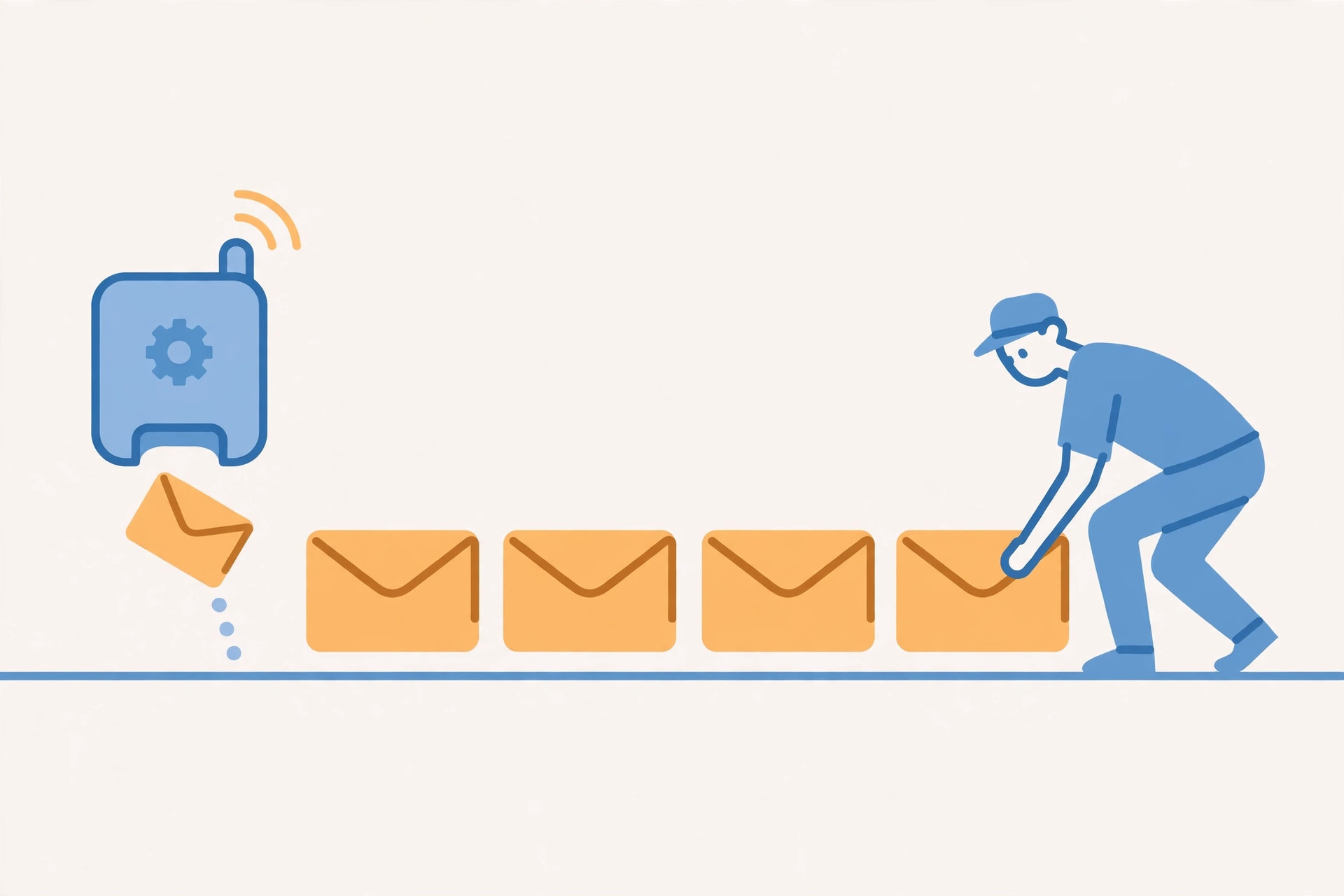
In a direct call, the caller waits. A REST API request to the email service blocks until it answers, so its slowness becomes your slowness and its outage becomes your outage. Add three more services and the checkout depends on all four being fast and healthy at the same instant.
A queue breaks that chain. The checkout handler writes one message — "order 101 placed" — to the queue and returns success at once. The email, stock, and warehouse workers each read from the queue at their own pace. If the email service goes down for an hour, messages simply wait; nothing is lost, no customer sees an error, and the backlog drains when the service returns. That decoupling — in time, in speed, and in availability — is the entire point.
2. How a message queue works, step by step
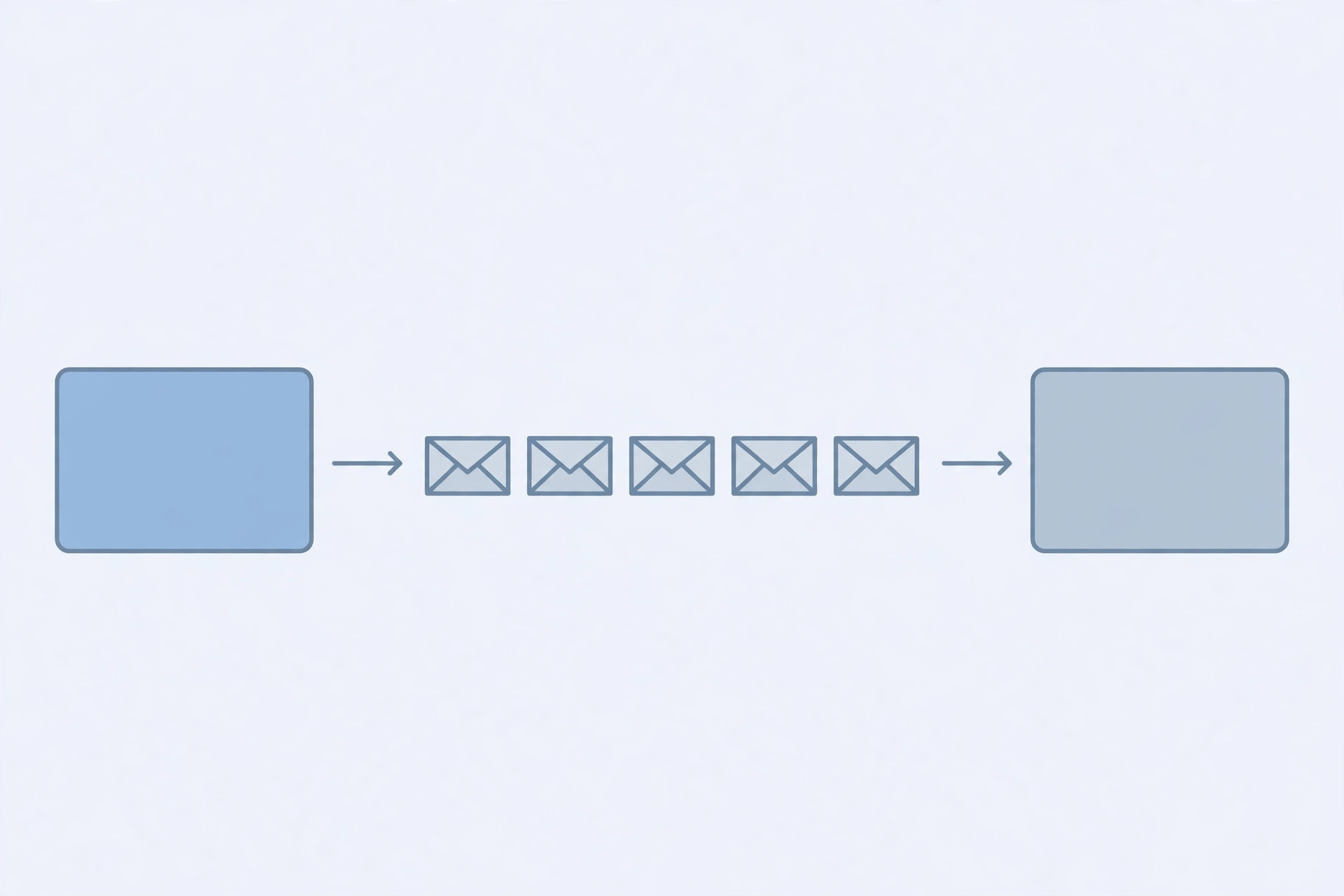
Every queue system has the same three parts, whatever the broker. The producer creates messages: small units of data describing a task. The broker holds the queues, routes messages, and enforces delivery rules. The consumer reads messages and does the work. Producer and consumer never call each other — both talk only to the broker.
- Publish. The producer sends a message to a named queue on the broker and moves on. It does not wait for processing, and it does not need to know who — if anyone — will handle the message.
- Store. The broker holds the message until a consumer is ready, in memory or durably on disk depending on configuration. Durable storage is what lets messages survive a broker restart.
- Deliver. A consumer takes one message, processes it, and then acknowledges it. Only the acknowledgement removes the message from the queue.
- Acknowledge — or redeliver. If the consumer crashes or never acknowledges, the broker makes the message visible again so another consumer can try. Receiving a message does not delete it; acknowledging it does.
A minimal version of that flow, run locally to verify the logic, looks like this:
from collections import deque

queue = deque()  # the broker's queue
dlq = deque()    # dead-letter queue
attempts = {}

def publish(body):
    queue.append(body)

def consume_once(fail_on):
    if not queue:
        return None
    msg = queue.popleft()
    if msg in fail_on:
        attempts[msg] = attempts.get(msg, 0) + 1
        if attempts[msg] >= 3:
            dlq.append(msg)  # give up: park it for inspection
            return ("dead-lettered", msg)
        queue.append(msg)  # no ack -> back on the queue
        return ("redelivered", msg)
    return ("processed", msg)
Run against a small test, the behaviour checks out: two good orders process normally, a broken payload is redelivered twice, and on the third failure it lands in the dead-letter queue instead of looping forever.
3. Two patterns: work queue vs publish/subscribe
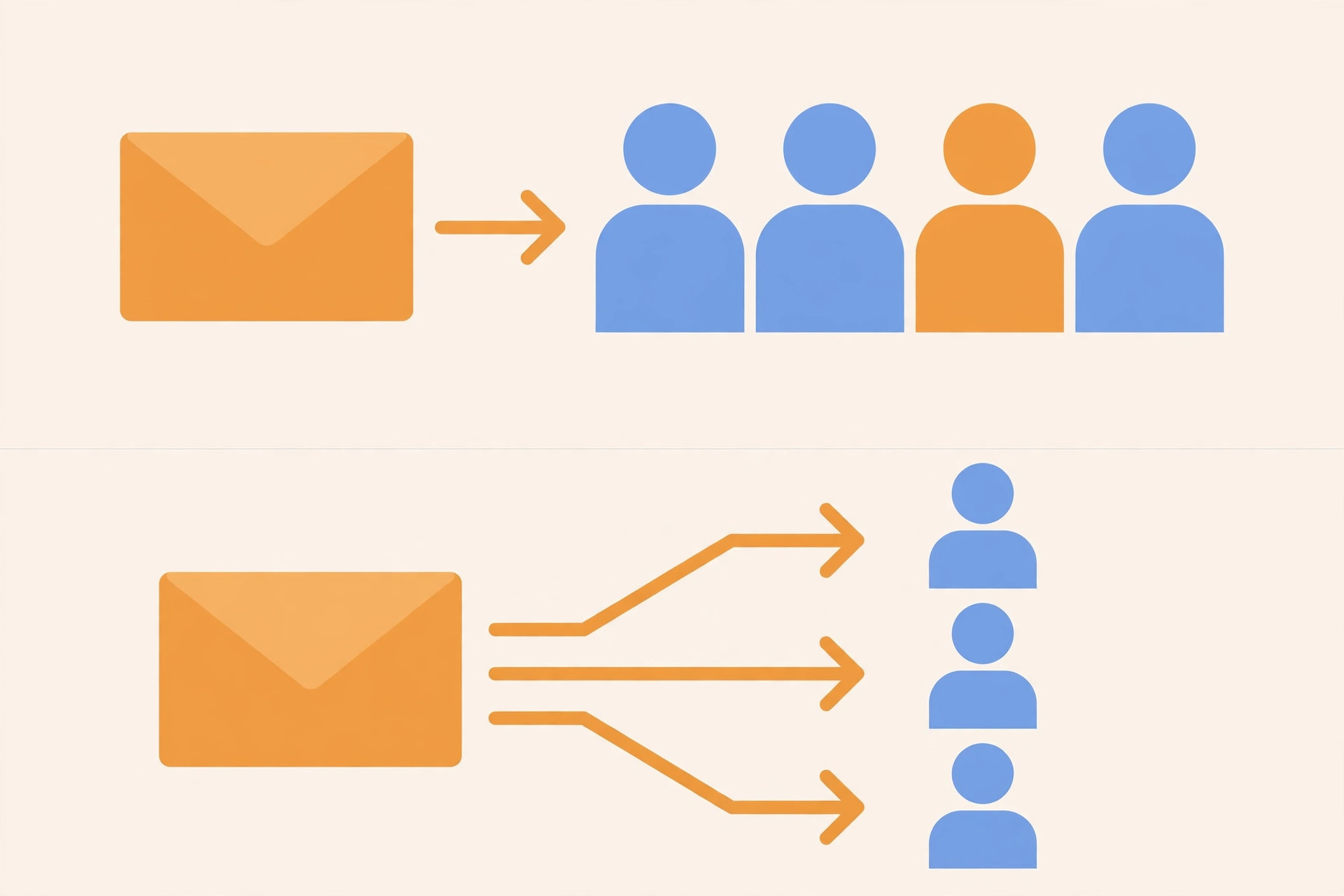
Queues come in two shapes, and mixing them up is the most common design mistake. In a work queue (point-to-point), each message is delivered to exactly one consumer. Ten workers sharing one queue split the work between them — the pattern for image resizing and email sending, where the job must be done once and any worker will do.
In publish/subscribe, each message is copied to every interested subscriber. One "order placed" event reaches the email, analytics, and warehouse services independently, and none blocks the others. Brokers implement this with topics or exchanges that fan one message out to many queues. The rule of thumb: one worker to do a job means a work queue; many systems reacting to one event means pub/sub.
4. Delivery guarantees: at-least-once, acknowledgements, and idempotency
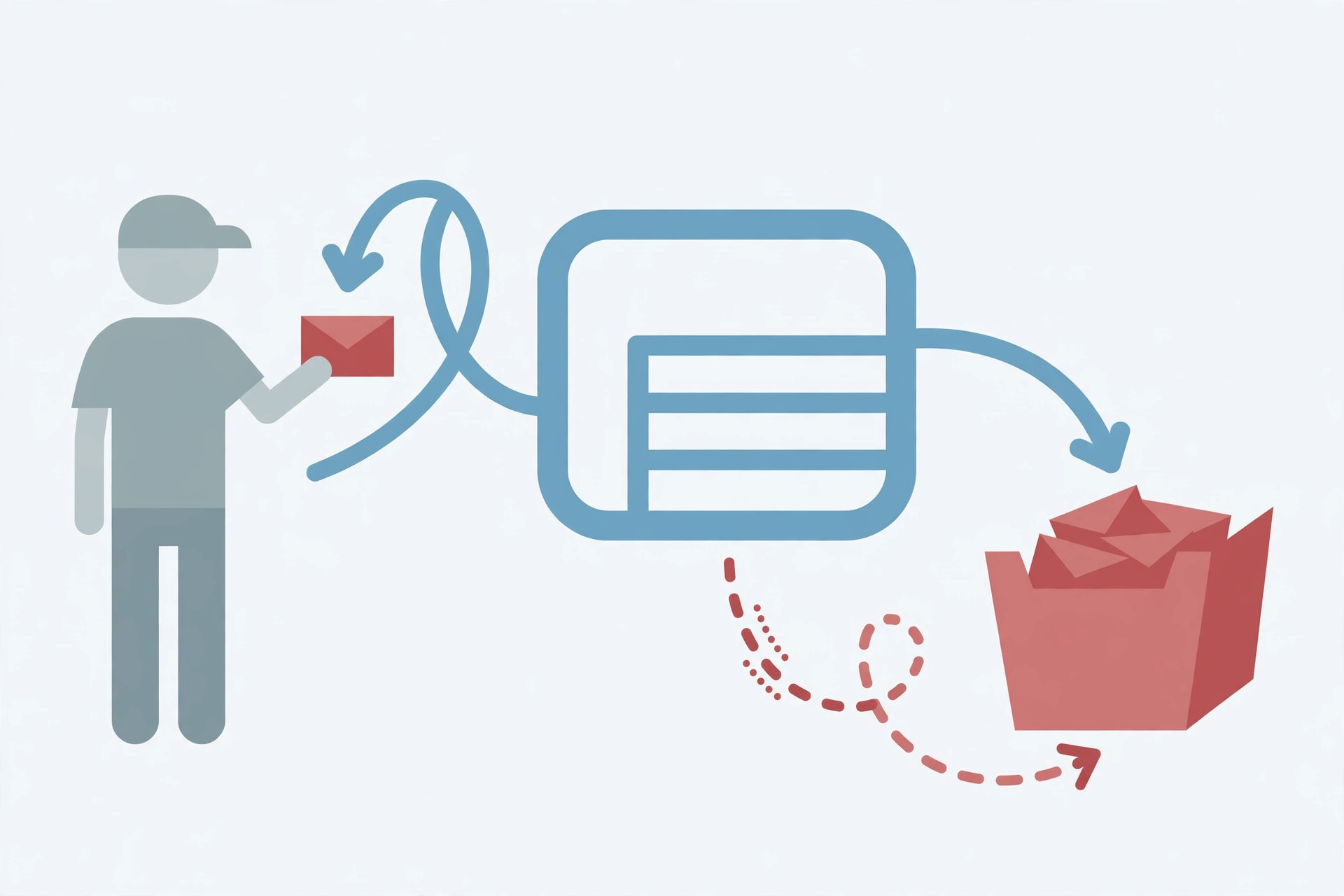
The acknowledgement is the reliability mechanism, and RabbitMQ's tutorial states it plainly: the ack tells the broker the message has been processed and may be deleted, and a consumer that dies without acking has its messages re-queued for another worker. That gives you at-least-once delivery: a message is never lost to a worker crash, but it may be delivered twice — if the worker finishes the job and then crashes before the ack arrives.
Duplicates are therefore a design input, not a surprise. The answer is an idempotent consumer: processing the same message twice must have the same effect as processing it once. Charging a card by order ID with a uniqueness check qualifies; blindly appending a credit every time does not. Some FIFO queues add deduplication over a short window, but that narrows the problem rather than removing it.
Two companion mechanisms complete the picture. A visibility timeout hides a received message from other consumers for a set period — Amazon SQS defaults to 30 seconds, up to 12 hours — so a slow worker is not doubled up on, while a dead worker's messages still come back. And fair dispatch (RabbitMQ's prefetch count of 1) stops the broker handing a second message to a worker still busy with its first.
5. Retries, backoff, and the dead-letter queue
Not every failure deserves an instant retry. A message that failed because a downstream service was briefly down may succeed in a minute; a message that fails because its payload is malformed will fail forever. Good consumers separate the two: retry transient failures with backoff — waiting longer between attempts so a struggling service is not hammered — and count attempts.
When the count runs out, the message goes to a dead-letter queue instead of looping forever. A poison message stuck at the head of a FIFO queue can block everything behind it, so the DLQ moves the problem aside and healthy work keeps flowing. The DLQ is then inspected — fixed and re-queued, or discarded deliberately. A queue with no DLQ and unlimited retries will one day stop processing anything at all.
6. Ordering, durability, and scaling the workers
Ordering is a trade-off, not a default. A plain queue delivers roughly in first-in, first-out order, but redeliveries and parallel workers break strict ordering: a retried message re-enters behind newer ones. If your system genuinely needs strict order — a ledger, a per-account stream — use a FIFO queue or a partitioned stream keyed so one account's messages always reach the same consumer, and accept the throughput cost.
Durability has two halves, and RabbitMQ's tutorial is explicit that both are needed: the queue itself must be declared durable, and each message must be marked persistent, or a broker restart still loses work — and even then a short window remains before the message reaches disk. Scaling is the easy part: when the backlog grows, add workers. The queue absorbs spikes the workers cannot yet handle, which is why queues pair so well with a load balancer in front of the producers and rate limiting on the intake.
7. When to use a queue — and when not to
Reach for a queue when the work is slow, bursty, or must survive a dependency's outage: sending email, resizing images, generating reports, syncing to a third-party service, or fanning one event out to several systems. It is also the right tool when producers and consumers must scale independently.
Do not reach for one when the caller needs the answer now: a login check, a price lookup, or a form validation cannot wait on a queue, because a queue has no reply channel — the caller would have to poll for a result it could have received directly. That is the job of a synchronous REST API call, or of a webhook in reverse, where the provider pushes the result to your URL when it is ready. For live updates to a browser, a WebSocket keeps one connection open instead of buffering messages. And for a single small program, a function call beats a broker every time.
Broker choice follows the same honesty. RabbitMQ is the classic general-purpose broker with routing, acknowledgements, and durable queues. Apache Kafka is a durable event log for replayable streams, not a task queue — use it when several systems need the same event history. Managed queues such as Amazon SQS remove the operations burden but bring their own semantics, like the visibility timeout above. An API gateway still sits in front: it routes and authenticates the synchronous request, and the handler behind it decides whether to answer now or enqueue for later.
Common mistakes to avoid
- Acknowledging on receipt instead of after processing. The message is deleted before the work is done, so a crash loses it.
- Assuming exactly-once delivery. Design the consumer to be idempotent; duplicates will happen.
- Retrying poison messages forever. Set an attempt limit and a dead-letter queue, or one bad message blocks the line.
- Storing large payloads in messages. Keep messages small — an ID plus a reference — and fetch the bulk data from storage.
A message queue is a disciplined trade: the producer gives up an immediate answer, and the system gains decoupling, buffering, and survival through outages. Build it that way — small messages, ack after work, idempotent consumers, bounded retries with a dead-letter queue — and it stays reliable. References: RabbitMQ's Work Queues tutorial and IBM's Introduction to message queuing.
Frequently asked questions
- What is a message queue in simple terms?
- A message queue is a waiting line for work between programs. One program (the producer) drops a message describing a task onto the queue, and another program (the consumer) picks it up and does the work later. The two programs never talk directly, and they do not need to be running at the same time.
- What is the difference between a message queue and a message broker?
- The queue is the waiting line itself: the named destination where messages sit until retrieved. The broker is the software that runs the queues — it stores, routes, and delivers messages, and provides features like acknowledgements, retries, and dead-letter queues. You talk to a broker; your messages wait in its queues.
- What is the difference between a message queue and pub/sub?
- In a work queue, each message goes to exactly one consumer — the pattern for distributing tasks across workers. In publish/subscribe, each message is copied to every interested subscriber — the pattern for broadcasting events. Many brokers support both, using queues for the first and topics or exchanges for the second.
- What happens if a consumer crashes while processing a message?
- With acknowledgements enabled, nothing is lost: the message was never acknowledged, so the broker makes it visible again and another consumer picks it up. This is exactly why you acknowledge only after the work is done, never on receipt. Without acknowledgements, a crash mid-task loses the message.
- What is a dead-letter queue?
- A dead-letter queue (DLQ) is a separate queue where messages go after they have failed too many times. Instead of retrying a broken message forever and blocking everything behind it, the broker parks it in the DLQ, where a developer can inspect it, fix the cause, and replay it — or discard it deliberately.
- What does at-least-once delivery mean?
- At-least-once means a message is guaranteed to be delivered one or more times, never zero times — but duplicates are possible, for example when a consumer finishes the work but crashes before acknowledging. The fix is an idempotent consumer: processing the same message twice must have the same effect as processing it once. True exactly-once delivery across distributed systems is not generally available; systems approximate it with deduplication plus idempotency.
- What is the difference between a message queue and event streaming?
- A queue is built for tasks: a message is consumed, acknowledged, and gone. An event stream, such as Apache Kafka, is built for events: messages are appended to a durable log that many consumers can replay from any point. Use a queue to distribute work; use a stream when several systems need the same history of events.
- When should I not use a message queue?
- Do not use one when the user is waiting for the answer in the same request — a queue adds latency by design, and the caller cannot get a reply from it. Do not use one for a single small program with no scaling or reliability need: a function call is simpler. And do not use one to hide a broken dependency — if the consumer is down for days, the queue fills up and becomes a second problem.
Related articles
What Is a Session? 7 Things Every Developer Should Know (With Examples)
What is a session? Learn how web sessions work — session IDs, server-side storage, expiry, and session vs cookie vs token — with code examples for developers.
Web DevelopmentWhat Is a Database Index? 7 Things Every Developer Should Know (With Examples)
What is a database index? Learn how database indexes work — B-trees, composite and covering indexes, write costs, and when not to index — with SQL examples.
Web DevelopmentWhat Is a Proxy Server? 7 Things Every Developer Should Know (With Examples)
What is a proxy server? Learn how proxy servers work for developers — forward vs reverse, HTTP vs SOCKS, CONNECT tunneling, and proxy vs VPN. With examples.