What Is a Service Mesh? 7 Things Every Developer Should Know (With Examples)
November 9, 2026 · Web Development
Ten services, each talking to the other nine: 90 connections to secure and monitor. So what is a service mesh? It is the infrastructure layer that takes that problem out of your code: proxies that every service-to-service call passes through, plus a control plane that configures them. This guide covers it in 7 parts: the definition, the two planes, the sidecar, the four jobs, sidecar vs ambient, a demo, and when to skip the mesh.
What is a service mesh?
A service mesh is a dedicated layer for service-to-service communication inside a distributed application. Istio's docs put it plainly: Istio is "an open source service mesh that layers transparently onto existing distributed applications" and gives you a uniform way to secure, connect, and monitor services with few or no code changes. The key word is layer: not a library, not a single server — a layer your traffic passes through.
One service calling another needs retries, timeouts, encryption, authentication, and metrics. With two services, that is one connection. With fifty, it is thousands, owned by many teams, in several languages — every team re-implementing the same behaviour slightly differently is how systems quietly become inconsistent. A mesh moves that behaviour into the infrastructure: defined once, applied everywhere.
Linkerd, created by Buoyant in 2016, was the first service mesh — its creators coined the term — and it joined the CNCF in early 2017 as the foundation's fifth project, graduating on 28 July 2021. Istio followed in 2017, launched by Google, IBM, and Lyft.

The two halves: data plane vs control plane
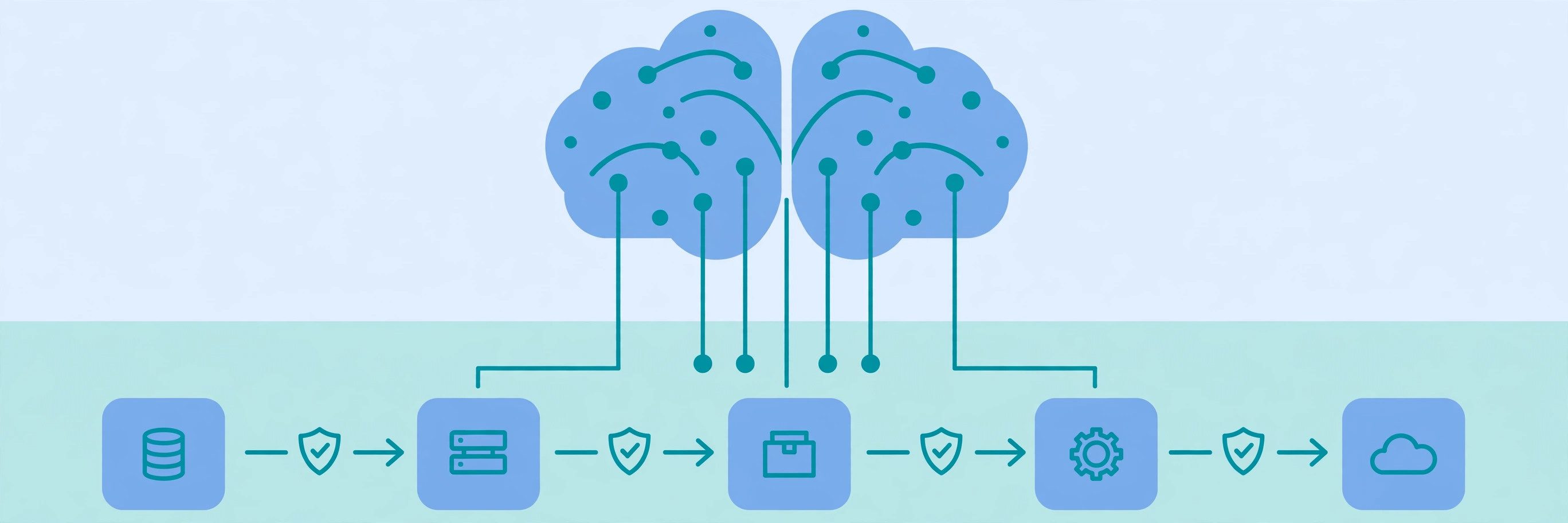
Every mesh splits into two halves, and the split is the whole design. The data plane is the set of proxies that carry your traffic: every request between services passes through them. The control plane is the management brain: it never touches a single request, but it configures, secures, and observes the proxies — distributing routing rules, certificates, and policy, and collecting telemetry. Istio's control plane, istiod, programs the proxies as rules or the environment change.
That separation makes the mesh manageable. You declare intent once — "only orders may call payments", "send 10% of checkout traffic to v2" — and the control plane configures every proxy. If a proxy crashes, only its traffic is affected; a new proxy picks up the same configuration.
The sidecar pattern — how interception actually works
The classic way to put a proxy on the data path is the sidecar pattern. In Kubernetes, the mesh injects an extra container — the sidecar proxy — into each pod beside your application. Network rules inside the pod send all traffic through that proxy first. Your code never notices: it still calls http://payments/charge as before, and the proxy intercepts the call, applies the rules, and forwards it. Istio's sidecar is Envoy; Linkerd's is its own small proxy written in Rust.
That interception is where the mesh's features live. The sidecar terminates the encrypted connection, checks the caller's identity, applies the routing rule, retries a failure, records how long the call took — then hands the request to your application on the loopback interface, exactly as if no mesh existed.

What a mesh actually does for you: four jobs
A mesh earns its place doing four jobs every distributed system needs, uniformly.
- Traffic management. The mesh routes requests by rules you declare: send 10% of traffic to the new version for a canary release, shift traffic away from a failing version, or retry a failed call once. It also load-balances per request and sheds load from an unhealthy instance — circuit breaking — instead of hammering a service that is down. Our load balancer guide covers the balancing half.
- Security. Every call inside the mesh is encrypted with mutual TLS, with both sides proving who they are. Istio gives each workload a SPIFFE identity — a URI like
spiffe://cluster.local/ns/payments/sa/checkout— issued as a short-lived certificate by the control plane, rotated automatically, so no application ever handles a key. Authorization policies then decide who may call whom, enforced on every request. For the transport half, see our HTTP vs HTTPS guide. - Observability. Because every request passes through a proxy, the mesh records metrics, logs, and traces for every hop automatically — latency, error rate, and volume per service — with no instrumentation code. That is the payoff most teams feel first: when checkout slows, you can see which hop is slow instead of guessing.
- Resilience. Retries, timeouts, and circuit breaking are policy, not code. A timeout on a slow dependency, one retry on a transient 500, and a circuit breaker that stops calling a service after repeated failures — the same rules for every service, so one team's missing retry cannot take down the whole call chain. Our message queue guide covers the alternative for work that does not need an immediate answer.
Sidecar vs ambient: the 2024 shift
The sidecar pattern has one obvious cost: a proxy per pod — hundreds of proxies in a large cluster, each consuming CPU and memory. Istio's own measurements: at 1,000 HTTP requests per second with 1 KB payloads and mutual TLS, a single sidecar proxy with two worker threads consumes about 0.20 vCPU and 60 MB of memory. Small per pod — large across a fleet.
Ambient mode is Istio's answer, generally available since Istio 1.24 (November 2024). It splits the proxy's work in two. A lightweight per-node proxy called ztunnel handles Layer 4 for everything on that node — encryption, identity, telemetry — at about 0.06 vCPU and 12 MB at the same 1,000 requests per second. Layer 7 features — routing, authorization policy, richer metrics — move to waypoint proxies, one per namespace or service account, only where asked. A waypoint costs about 0.25 vCPU and 60 MB, like a sidecar, but you run a few instead of one per pod. Enrol a namespace by labelling it istio.io/dataplane-mode=ambient; no sidecar is injected at all.
The trade-off is granularity: a sidecar gives per-pod control; ambient gives most of the mesh for a fraction of the overhead, with Layer 7 features at namespace level. For a new mesh in 2026, ambient is the sensible default. Linkerd never used Envoy sidecars at all: its Rust micro-proxy was designed to be small enough that the sidecar cost barely registers, which is why its fans call it the simplest mesh to operate.

Verified demo: a miniature data plane in Python
A real mesh needs a Kubernetes cluster, so this demo is a miniature model of the data-plane idea: two backends (checkout v1 and v2) and a proxy standing in for the sidecar. The proxy intercepts every request, injects an identity header — standing in for a real mesh's SPIFFE identity — splits traffic 90/10, and retries once on a 500. The v1 backend fails its first request on purpose, so the retry has something to catch.
# The proxy: intercept, identify, split, retry (mesh-demo.py)
def do_GET(self):
    count['n'] += 1
    # 90/10 canary: every 10th client request goes to v2
    target = 9102 if count['n'] % 10 == 0 else 9101
    ident = 'spiffe://cluster.local/ns/default/sa/orders'
    status, body = call(target, ident)          # identity attached
    if status >= 500:
        print(f'  [proxy] {status} from v{target - 9100}; retrying once')
        status, body = call(target, ident)      # one retry, same target
    self.send_response(status)
    self.wfile.write(body.encode())
Ten requests through the proxy, verified in this run:
$ python3 mesh-demo.py
--- 10 requests through the sidecar proxy ---
  [proxy] 500 from v1; retrying once
req  1 -> HTTP 200 {"service": "checkout", "version": "v1",
                    "seen_identity": "spiffe://cluster.local/ns/default/sa/orders"}
req  2 -> HTTP 200 {"service": "checkout", "version": "v1",
                    "seen_identity": "spiffe://cluster.local/ns/default/sa/orders"}
...
req 10 -> HTTP 200 {"service": "checkout", "version": "v2",
                    "seen_identity": "spiffe://cluster.local/ns/default/sa/orders"}
Three things happened, exactly as a mesh does them. First, the proxy caught the simulated crash: request 1 hit a 500 from v1, the proxy retried once, and the client still got a 200. Second, nine requests went to v1 and the tenth to v2: the 90/10 canary split, the mechanism a real mesh uses for gradual rollouts. Third, every backend saw the same identity header — in a real mesh that identity is a certificate, not a header, but the idea is identical: the proxy, not the application, proves who is calling. This is a model of interception, not a mesh: a real mesh adds certificate issuance, service discovery, and policy enforcement no ten-line proxy can fake.
Service mesh vs API gateway vs load balancer — and when NOT to use one
All three sit between a caller and a service. The difference is direction and scope:
| Layer | Traffic | Job | Example |
|---|---|---|---|
| API gateway | North-south (clients in) | One front door: routing, auth, rate limiting, aggregation | Our API gateway guide |
| Service mesh | East-west (services to services) | Every internal call: mTLS, routing, retries, observability | Istio, Linkerd, Cilium |
| Load balancer | Any direction | Spread traffic across healthy instances of one service | Our load balancer guide |
A gateway and a mesh do not compete — most systems that need a mesh also have a gateway at the edge, often running inside the mesh. A proxy server is the building block underneath all three: a mesh is, at its core, a fleet of proxies with a control plane, and our reverse proxy guide shows the same idea in its simplest form. Our gRPC guide pairs naturally with a mesh, which encrypts and observes gRPC traffic just like HTTP.
So when should you not use a mesh? With a handful of services and one team, the mesh's own cost — installing, upgrading, and debugging it — outweighs what it saves. A shared library, a gateway at the edge, and a load balancer in front of each service cover the same needs with far less to operate. A mesh earns its keep when many services all need the same traffic, security, and observability behaviour, and keeping it consistent by hand has become the bottleneck.
A service mesh is the layer that takes service-to-service communication out of your code: proxies on the data plane carry every call, a control plane configures them, and the same traffic, security, and observability rules apply everywhere. Pick the lightest mesh that solves it: Linkerd for simplicity, Istio ambient mode for depth without the per-pod proxy tax. Read the Istio "What is Istio?" docs and Istio's performance page, which publishes the sidecar, waypoint, and ztunnel numbers used above.
Frequently asked questions
- What is a service mesh in simple terms?
- A service mesh is a dedicated layer of proxies that sits between your services and handles everything about how they talk to each other — routing, encryption, retries, and monitoring — so your application code does not have to. Each service keeps making plain calls; the proxies add security and reliability on the way.
- What is the difference between a service mesh and an API gateway?
- An API gateway sits at the edge and handles traffic coming into your system from clients — north-south traffic. A service mesh handles traffic between your own services inside the system — east-west traffic. They complement each other: the gateway is the front door, the mesh is the corridors and locked doors inside.
- Do I need a service mesh for a small application?
- Usually not. If you have a handful of services owned by one team, a shared library, an API gateway, and a load balancer cover the same needs with far less to operate. A mesh earns its keep when many services, owned by many teams, all need the same traffic, security, and observability behaviour — and keeping that behaviour consistent by hand has become the bottleneck.
- What is a sidecar proxy?
- A sidecar proxy is a small proxy process that runs alongside your application — in Kubernetes, as a second container in the same pod. All traffic in and out of your application passes through it, so the mesh can encrypt, route, retry, and measure requests without changing your code. Envoy is the proxy Istio uses; Linkerd uses its own Rust proxy instead.
- What is Istio ambient mode?
- Ambient mode is Istio's sidecarless way of running a mesh, generally available since Istio 1.24 (November 2024). Instead of one proxy per pod, a lightweight per-node proxy called ztunnel handles Layer 4 security and identity for everything on that node, and optional per-namespace waypoint proxies add Layer 7 features like routing and policy only where you ask for them.
- What is mTLS in a service mesh?
- Mutual TLS is TLS where both sides prove who they are, not just the server. The mesh gives every workload a cryptographic identity — in Istio, a SPIFFE ID like spiffe://cluster.local/ns/payments/sa/checkout — and issues short-lived certificates automatically. Two services then encrypt their traffic and verify each other's identity on every call, with no code changes and no shared secrets to manage.
- Istio or Linkerd — which service mesh should I choose?
- Istio is the feature-rich choice: the widest traffic controls, the biggest ecosystem, and ambient mode for lower overhead — at the cost of more to learn and operate. Linkerd is the simple choice: deliberately small, fast, and easy to run, built around one Rust proxy. If you are unsure, Linkerd's simplicity is the safer first mesh; if you know you need Istio's depth, start with ambient mode.
- Does a service mesh replace Kubernetes networking?
- No. Kubernetes still does service discovery, pod networking, and basic load balancing — a mesh builds on top of that. The mesh adds what Kubernetes does not provide: per-request routing rules, mutual TLS between services, retries and circuit breaking, and per-service metrics and traces. Think of Kubernetes as the roads and the mesh as the traffic rules, locks, and speed cameras.
Related articles
What Is a DNS Record? 9 Record Types Explained (With a Real dig Demo)
What is a DNS record? 9 types — A, AAAA, CNAME, MX, TXT, NS, SOA, PTR, CAA — explained with dig output from a live domain and the mistakes that break sites.
Web DevelopmentWhat Are Server-Sent Events? 7 Things Every Developer Should Know (With Examples)
What are server-sent events? Learn how SSE streams live updates over plain HTTP — event format, EventSource, reconnection, SSE vs WebSocket and a verified demo.
Web DevelopmentWhat Is a URL Slug? 7 Things Every Developer Should Know (With Examples)
What is a URL slug? Learn how slugs work — anatomy, Google's hyphen rule, a verified slugify demo, non-ASCII handling, and when never to rename one. Read on.